
Anti-Atlas, Drâa-Tafilalet, Morocco
Tazoult Silver Mine
The group’s first primary silver mine and its first asset outside sub-Saharan Africa, acquired in February 2026. Tazoult is a high-grade underground operation in the Moroccan Anti-Atlas that comes with a genuine water dispute attached to it.
- Annualised silver
- 4.1 Moz
- Ore reserve
- 6.4 Mt @ 232 g/t Ag
- Mine life
- 11 years
- AISC
- US$13.40/oz
Overview
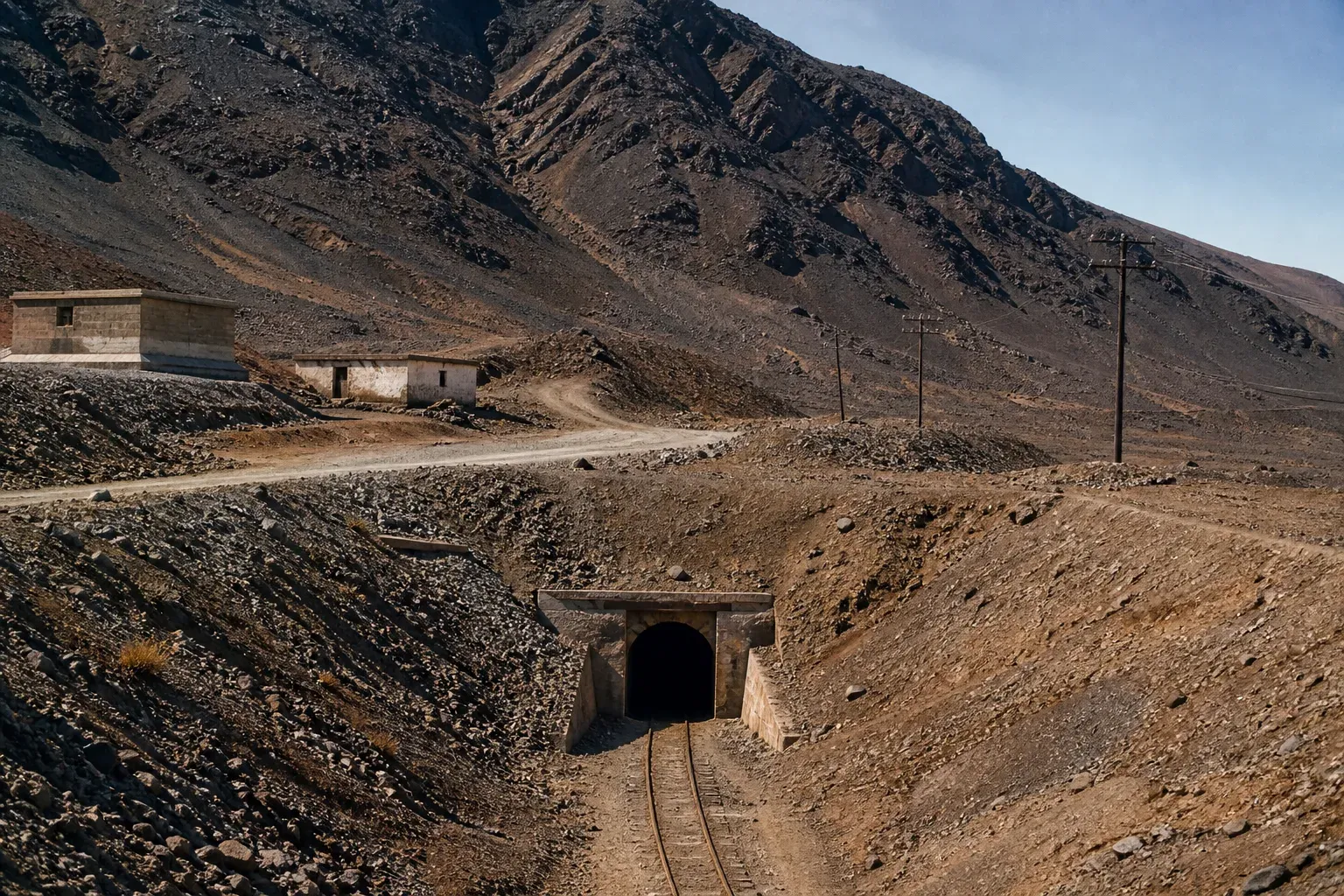
Tazoult is a high-grade underground silver mine on the northern flank of the Jbel Saghro massif, in the Moroccan Anti-Atlas. It has been in continuous production since 1996 under two previous owners and produced 4.12 million ounces of silver in calendar 2025, which makes it one of the larger primary silver mines on the African continent. Quintel completed the acquisition of 75% of the operating company on 20 February 2026 for US$318 million in cash, funded from the balance sheet and a partial drawing on the group revolving facility.
This is the group’s fifth commodity, its seventh operating mine and its first asset outside sub-Saharan Africa. It was bought for three reasons. The deposit is high-grade and structurally simple, the previous owner had under-invested in it for a decade in a way that is straightforward to correct, and silver has an industrial demand profile — photovoltaic paste above all — that fits the same thesis as our copper business rather than a purely precious-metals one.
It was also bought with a dispute attached. Between 2011 and 2020 villagers from the surrounding communes occupied the mine’s borehole pumping station in protest at groundwater abstraction in a semi-arid region. That dispute was settled, not resolved, and the settlement capped abstraction rather than ending it. We describe it in detail below, because a reader who finds out about it from somewhere other than this page is entitled to conclude we were hiding it.
Geology and resource
Tazoult is an unconformity-related epithermal silver deposit, a type that is uncommon globally and characteristic of this part of the Anti-Atlas. Mineralisation sits at and immediately above the contact between Ediacaran volcanic and volcaniclastic rocks of the Ouarzazate Group and the underlying Neoproterozoic schists and quartzites, and is controlled by a set of steep east-north-east structures and the breccia bodies developed along them.
The silver occurs as native silver, acanthite and silver amalgam, with mercury present as a natural constituent of the ore rather than as a processing additive. Grades are high and erratic at the sample scale: the reserve averages 232 grams per tonne but individual structures assay in the kilograms per tonne. Grade control is therefore the single most important technical discipline on the site, and it is where the previous owner spent least.
The deposit has been traced over 3.1 kilometres of strike and to 420 metres below surface, and it remains open at depth. Resources and reserves are estimated under the JORC Code (2012) and were independently reviewed as part of our acquisition due diligence; the reviewing Competent Person’s report is available on request.
Mineral resources and ore reserves
| Category | Tonnes (Mt) | Grade (g/t Ag) | Contained Ag (Moz) |
|---|---|---|---|
| Proved reserve | 3.9 | 248 | 31.1 |
| Probable reserve | 2.5 | 207 | 16.6 |
| Total ore reserve | 6.4 | 232 | 47.7 |
| Measured resource | 4.6 | 241 | 35.6 |
| Indicated resource | 5.1 | 198 | 32.5 |
| Inferred resource | 3.4 | 186 | 20.3 |
Mineral resources are reported inclusive of ore reserves. Reserves are estimated at a silver price of US$24.00/oz and a cut-off grade of 95 g/t Ag. Our restatement reduced the previous owner’s stated reserve by 8.4%, principally by reclassifying material where drill spacing did not support the proved category.
Mining
Access is by two declines and a ventilation shaft. Mining is by cut-and-fill and, in the wider breccia zones, by longhole open stoping with cemented rockfill. Ore is trucked to surface through the main decline; there is no hoisting shaft, which limits throughput but keeps capital intensity low and makes the mine unusually flexible about where it takes ore from in any given month.
The mine produced 570 kilotonnes of ore in 2025 at a mined grade of 245 grams per tonne. Development rates are the binding constraint on production, and they are the first thing we are changing: two additional jumbos arrived in April 2026 and development advance is budgeted to rise from 3,100 to 4,800 metres a year.
Ground conditions in the breccia bodies are poor and the previous owner’s ground support standard had not been revised since 2014. It was rewritten in the first sixty days of our ownership and re-issued with mandatory resin-anchored bolting and mesh in all development headings, which cost about eleven days of production to implement. Two of the three lost-time injuries recorded at the mine in 2025 were rockfall-related.
Processing, doré and mercury
Ore is crushed and milled to a P80 of 75 microns, leached in cyanide with counter-current decantation, and the silver is precipitated with zinc dust in a Merrill–Crowe circuit. Merrill–Crowe rather than carbon-in-pulp is the standard choice at these silver grades, and recovery averaged 92.1% in 2025. Precipitate is retorted and smelted on site into doré bars grading approximately 92% silver, which are refined under contract at an LBMA Good Delivery silver refinery in Europe.
The mercury that occurs naturally in the ore is volatilised in the retort, condensed and captured. Under the Minamata Convention, mercury recovered from primary silver production may not be sold or re-enter commerce. It is converted to mercury sulphide, drummed and held in a licensed, monitored store on site pending permanent disposal at an approved facility. Roughly 1.9 tonnes accumulates each year. The previous owner’s store was compliant but full; construction of a second cell began in May 2026.
Mercury is also an occupational health question, not only a waste question. Everyone who works in the retort, smelting and gold room areas is on a biological monitoring programme with urinary mercury testing every eight weeks. Two employees exceeded the action level in 2025 under the previous owner and were removed from exposure; both have since returned to work below the action level, and the ventilation in the retort house is being rebuilt.
Operating record
| Metric | 2023 | 2024 | 2025 | 2026 guidance |
|---|---|---|---|---|
| Ore milled (kt) | 548 | 561 | 570 | 480 – 510 |
| Head grade (g/t Ag) | 258 | 251 | 245 | 240 – 250 |
| Recovery (%) | 91.4 | 91.8 | 92.1 | 92.0 – 93.0 |
| Silver produced (Moz) | 4.16 | 4.15 | 4.12 | 3.2 – 3.5 |
| AISC (US$/oz) | 12.10 | 12.90 | 13.40 | 14.50 – 15.50 |
| Sustaining capital (US$m) | 18 | 16 | 14 | 46 |
The 2026 guidance range covers roughly ten months of Quintel ownership and reflects the eleven days lost to the ground support standstill, a deliberate slowing of stope turnover while grade control is rebuilt, and a tripling of sustaining capital. On an annualised basis production is broadly flat; costs are not, and will not be until the development rate catches up.
Water: the dispute we bought
The Anti-Atlas receives between 120 and 180 millimetres of rain a year. Agriculture in the valleys below the mine depends on a shallow alluvial aquifer recharged by seasonal flows and on a system of springs and traditional khettara galleries that are, in some cases, several centuries old. The mine draws water from boreholes in the same catchment.
In 2011 villagers from the surrounding communes occupied the mine’s pumping station, arguing that abstraction was drawing down the springs their farming depended on. The occupation lasted in various forms until 2020 and at times cut the mine’s water supply entirely. It ended in a negotiated settlement that capped abstraction at 380,000 cubic metres a year, funded a village water supply scheme, and provided compensation to affected households. It did not end abstraction from the shared aquifer, and it did not produce an agreed answer to the underlying question of whether the mine or the drought was responsible for the decline in the springs.
We do not think that question can be answered by either side asserting it. Within our first month we commissioned an independent hydrogeological study of the catchment, jointly scoped with the commune councils, with one of the three hydrogeologists nominated by the communities and all raw data published to the councils as it is collected rather than at the end. The study reports in the second quarter of 2027.
Three commitments do not wait for the study. We will not increase abstraction above the capped level under any circumstances. We are converting the tailings facility from conventional wet deposition to filtered dry stacking, which is the single largest water saving available at this site and removes roughly 40% of current consumption when complete in 2028. And we are funding a pipeline from the treated effluent of the nearest municipal works, which is expected to replace most of the balance by 2029.
The honest position: if the study concludes that mine abstraction is materially responsible for the decline in the springs, we will have to reduce throughput, and we have said so to the commune councils in writing. We would rather commit to that now than argue about it later from a position where we have already spent the capital.
Tailings and closure
Tazoult brings the group’s tailings facility count from eight to nine, and the facility it brings is the least conforming one we own.
- The legacy facility: a conventional upstream-raised wet tailings dam commissioned in 1996 and raised six times. It is classified as significant consequence. It does not currently conform to the Global Industry Standard on Tailings Management, and bringing it into conformance is the largest single item in our first capital programme.
- Immediate measures: an independent Engineer of Record was appointed in March 2026, piezometer and inclinometer instrumentation has been trebled, and the facility has been placed under monthly rather than annual independent review until conformance is achieved.
- Dry stacking: a filtration plant is under construction for commissioning in 2028. From that point new tailings are deposited as a filtered, compacted dry stack, the wet facility is capped and progressively rehabilitated, and the water recovered goes back into the process circuit.
- Closure provision: the previous owner carried a closure provision of US$18 million. Our own estimate, prepared by an independent closure specialist during due diligence, is US$52 million. The difference is funded and held in a ring-fenced instrument, not carried as an unfunded balance-sheet number.
- Post-closure water: the closure plan assumes the site requires active water management for at least thirty years after mining stops. That obligation is costed in the provision above.
Energy and emissions
The mine draws from the Moroccan national grid, which has a materially lower carbon intensity than the grids in our sub-Saharan operations, and it sits ninety kilometres from one of the largest concentrated solar complexes in the world. Acquiring Tazoult therefore improves the group’s average Scope 2 intensity even before we do anything.
A 20 MW photovoltaic plant with 12 MWh of battery storage is in permitting for construction in 2027 on already-disturbed ground north of the plant. Combined with the grid mix it is expected to take the operation to roughly 80% non-fossil electricity, the highest of any Quintel site. Diesel remains for underground mobile equipment; the two haul trucks due for replacement in 2028 will be tendered as battery-electric with diesel as the fallback rather than the base case.
Adding Tazoult increases absolute group Scope 1 and 2 emissions by approximately 34 kt CO₂e a year. Our 2030 reduction target is expressed against a 2019 baseline that does not include this asset, and rather than quietly rebase the target we are keeping the original baseline and reporting the acquisition’s contribution separately. That makes our reported progress look worse. It is the correct treatment.
People and the communities around the mine
Tazoult employs 640 people directly and 210 through contractors. Ninety-six per cent are Moroccan nationals and 71% were recruited from within the Drâa-Tafilalet region. The working language of the region is Tamazight; French and Arabic are used in administration. Safety instruction, permits to work, hazard reporting and the right-to-stop-work card are being translated into Tamazight, which the previous owner had not done, on the straightforward basis that a safety instruction a worker cannot read is not a safety instruction.
The mine is the largest formal employer in its commune by a wide margin, which is a source of both dependence and leverage, and it means the site’s social licence cannot be managed with a community investment budget alone. The Tazoult Regional Development Trust holds 5% of the operating company on behalf of the surrounding communes, received its first distribution in the 2026 half year, and has two seats and full information rights at the site social performance committee.
Roughly 190 people work informally on old workings and waste dumps in the licence area, recovering silver-bearing material by hand. This is not a problem we intend to solve by eviction. We have begun a mapping exercise with the commune councils and a regional NGO to understand who these people are and what they earn, ahead of proposing a formalisation route. We do not yet have an answer and we are not going to pretend otherwise.
Asset history
How Tazoult got here
- 1969
First modern exploration of the Tazoult vein system by a state geological survey programme.
- 1996
Previous owner begins commercial production at 180 ktpa through a small oxide plant.
- 2011
Villagers occupy the mine’s borehole pumping station in a dispute over groundwater. The occupation lasts, in various forms, for nine years.
- 2017
Plant expanded to 570 ktpa; production passes 4 Moz of silver for the first time.
- 2020
Negotiated settlement ends the pumping station occupation. Abstraction from the shallow aquifer is capped but not stopped.
- 2024
Previous owner enters a court-supervised restructuring; the mine is put up for sale as a going concern.
- 2026
Quintel acquires 75% for US$318 million in cash and takes over operatorship on 20 February.
Reporting standard
Mineral resources and ore reserves for this asset are estimated in accordance with the JORC Code (2012) and reviewed annually by an independent Competent Person. Resources are reported inclusive of reserves. Production figures are as reported in the FY2025 Annual Review.
Full resource and reserve statementLocation
Where this asset sits in the portfolio
Schematic map. Marker positions indicate the operating district, not a licence boundary.
- Producing
- Development
- Exploration
- Mbengwe Copper ComplexCopperbelt Province, Zambia · CopperProducing
- Lubumba Copper-Cobalt OperationLualaba Province, Democratic Republic of the Congo · Copper, CobaltProducing
- Asankran Gold MineWestern North Region, Ghana · GoldProducing
- Tazoult Silver MineAnti-Atlas, Drâa-Tafilalet, Morocco · SilverProducing
- Gamagara Manganese MineNorthern Cape, South Africa · ManganeseProducing
- Nyanga Manganese OperationHaut-Ogooué Province, Gabon · ManganeseProducing
- Fatala Bauxite OperationBoké Region, Guinea · BauxiteProducing
- Bagoé Gold ProjectSavanes District, Côte d'Ivoire · GoldDevelopment
- Erongo Copper ExplorationErongo Region, Namibia · CopperExploration
Seven operating mines, two development assets and 9 offices across nine countries. Every operation is managed by Quintel; we do not hold non-operated minority interests.
Enquiries
Questions about Tazoult?
Community, procurement, media and offtake enquiries relating to this operation route to a named contact in the country where it operates.