
Erongo Region, Namibia
Erongo Copper Exploration
A greenfield sediment-hosted copper search across 1,840 square kilometres of the Namibian Erongo region, targeting a maiden resource in 2027.
- Licence area
- 1,840 km²
- Drilled to date
- 34,000 m
- Ownership
- 100%
- Maiden resource
- Targeted 2027
Why Namibia
Quintel’s stated strategy is to replace every tonne of copper it mines. Buying developed assets at the top of a copper cycle is the expensive way to do that. Finding them is the cheap way, and it is also the slow, uncertain, mostly unsuccessful way — which is precisely why the group allocates a fixed, modest percentage of operating cash flow to exploration rather than a variable amount that rises and falls with the copper price.
Namibia was selected for three reasons: prospective and under-explored Neoproterozoic stratigraphy on the same craton margin that hosts the Central African Copperbelt; a mineral licensing regime that is transparent, administered on published timelines and has never expropriated a licence; and existing infrastructure — the Walvis Bay corridor — that the group already uses for Zambian copper exports.
The geological thesis
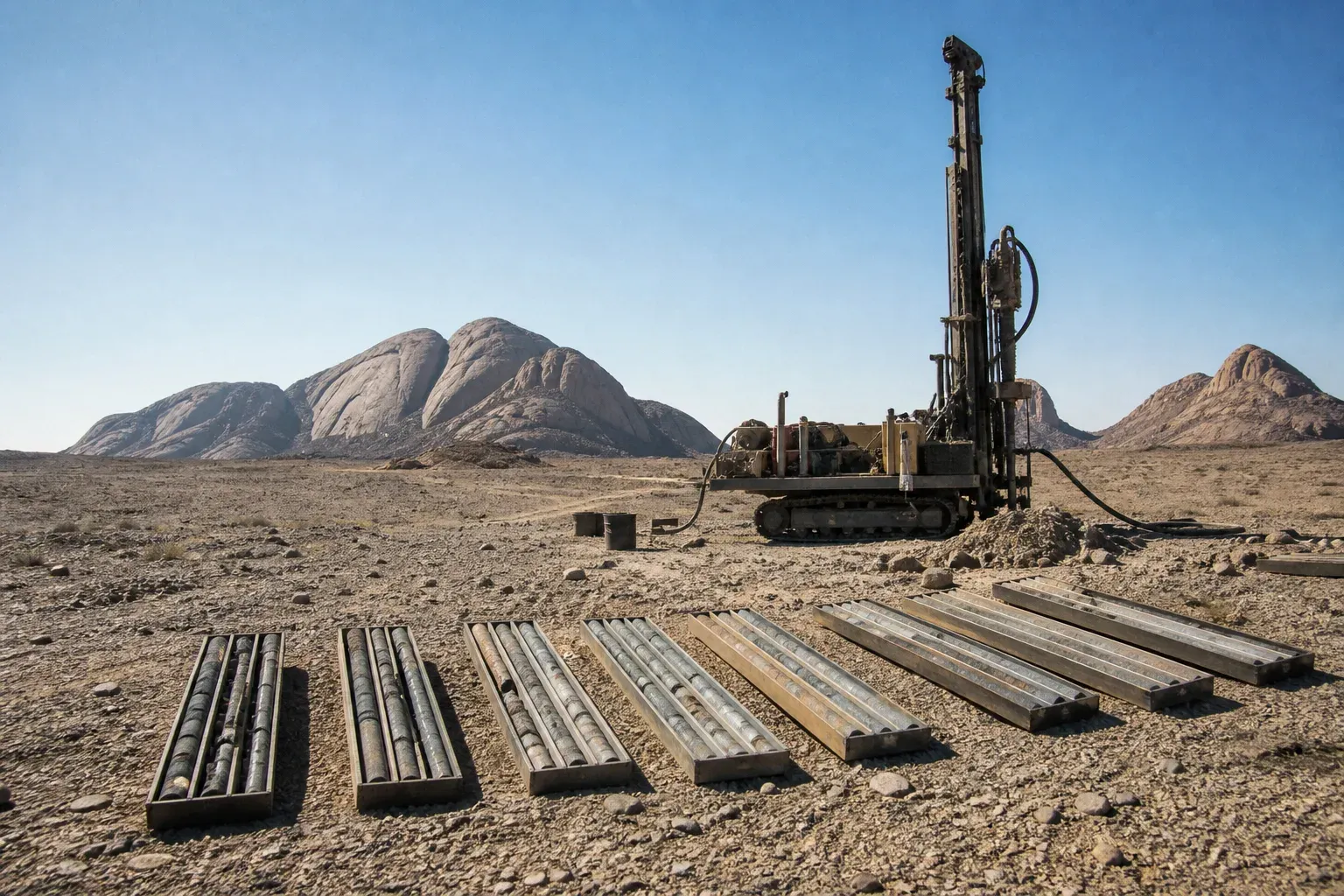
The target model is sediment-hosted stratiform copper in the Damara Supergroup, in a reduced-facies setting analogous to the Copperbelt but developed on the southern margin of the Congo Craton. Historical work in the region concentrated on outcropping showings; the group’s thesis is that the prospective horizon continues beneath 40 to 120 metres of Kalahari sand cover that earlier explorers could not see through and did not test.
A regional airborne electromagnetic and gravity survey flown in 2023 mapped the basin architecture beneath that cover for the first time, identifying nine conductive targets on the interpreted redox boundary. Scout drilling in 2024 intersected copper mineralisation at three of them, including 34 metres at 1.41% copper from 168 metres at the target now named Otjiwa.
Programme summary
| Activity | Completed | FY2026 plan |
|---|---|---|
| Airborne geophysics | 4,800 line-km | Infill AEM over Otjiwa corridor |
| Soil and calcrete geochemistry | 18,400 samples | 6,000 samples |
| Diamond drilling | 21,600 m | 14,000 m |
| Reverse circulation drilling | 12,400 m | 8,000 m |
| Exploration spend | US$28.4 million | US$16 million |
How we explore
Exploration is the part of mining where a company’s honesty is easiest to test, because the results are numbers and the numbers either continue or they do not. Quintel reports drilling results in full, including the holes that fail, and publishes intercepts with the full assay interval rather than selected high-grade sub-intervals.
Access agreements are negotiated with communal conservancy committees and commercial farmers before a drill rig moves, not after. Drill sites are rehabilitated within 90 days of completion, water for drilling is trucked rather than abstracted locally in a country where groundwater is scarce and contested, and every sump is lined and backfilled.
The programme employs 46 people, 41 of them Namibian, and uses a Namibian drilling contractor and a Namibian sample preparation laboratory with umpire assays at an accredited international laboratory.
What happens next
The FY2026 programme concentrates 22,000 metres of drilling on the Otjiwa corridor, where mineralisation has now been traced over 2.4 kilometres of strike and remains open in both directions. A maiden mineral resource estimate is targeted for 2027 if drill density and grade continuity support one.
The group makes no claim that Erongo will become a mine. Most exploration programmes do not. What can be said is that the target is real, the stratigraphy is prospective, the ground is held 100% and the drilling is funded through 2027 regardless of the copper price.
Asset history
How Erongo got here
- 2022
Four exclusive prospecting licences granted over 1,840 km².
- 2023
Regional airborne electromagnetic and gravity survey flown.
- 2024
First scout drilling programme; copper intersected at three of nine targets.
- 2025
Infill drilling on the two priority targets; 34,000 m cumulative.
- 2027
Maiden mineral resource estimate targeted.
Reporting standard
Mineral resources and ore reserves for this asset are estimated in accordance with the JORC Code (2012) and reviewed annually by an independent Competent Person. Resources are reported inclusive of reserves. Production figures are as reported in the FY2025 Annual Review.
Full resource and reserve statementLocation
Where this asset sits in the portfolio
Schematic map. Marker positions indicate the operating district, not a licence boundary.
- Producing
- Development
- Exploration
- Mbengwe Copper ComplexCopperbelt Province, Zambia · CopperProducing
- Lubumba Copper-Cobalt OperationLualaba Province, Democratic Republic of the Congo · Copper, CobaltProducing
- Asankran Gold MineWestern North Region, Ghana · GoldProducing
- Tazoult Silver MineAnti-Atlas, Drâa-Tafilalet, Morocco · SilverProducing
- Gamagara Manganese MineNorthern Cape, South Africa · ManganeseProducing
- Nyanga Manganese OperationHaut-Ogooué Province, Gabon · ManganeseProducing
- Fatala Bauxite OperationBoké Region, Guinea · BauxiteProducing
- Bagoé Gold ProjectSavanes District, Côte d'Ivoire · GoldDevelopment
- Erongo Copper ExplorationErongo Region, Namibia · CopperExploration
Seven operating mines, two development assets and 9 offices across nine countries. Every operation is managed by Quintel; we do not hold non-operated minority interests.
Enquiries
Questions about Erongo?
Community, procurement, media and offtake enquiries relating to this operation route to a named contact in the country where it operates.