
Boké Region, Guinea
Fatala Bauxite Operation
The group’s newest and longest-life operation. Fatala mines high-alumina, low-silica trihydrate bauxite in Guinea and ships it to alumina refineries in Europe, the Gulf and Asia.
- FY2025 shipped
- 4.41 Mt
- Ore reserve
- 320 Mt @ 45.8% Al₂O₃
- Reactive silica
- 2.1% SiO₂
- Mine life
- 28 years
Overview
Guinea holds roughly a quarter of the world’s bauxite reserves and has become the largest exporter of the ore that becomes alumina and, eventually, aluminium. Fatala is Quintel’s operation in the Boké region, developed from first drilling in 2019 to first shipment in 2021 — the fastest project delivery in the group’s history.
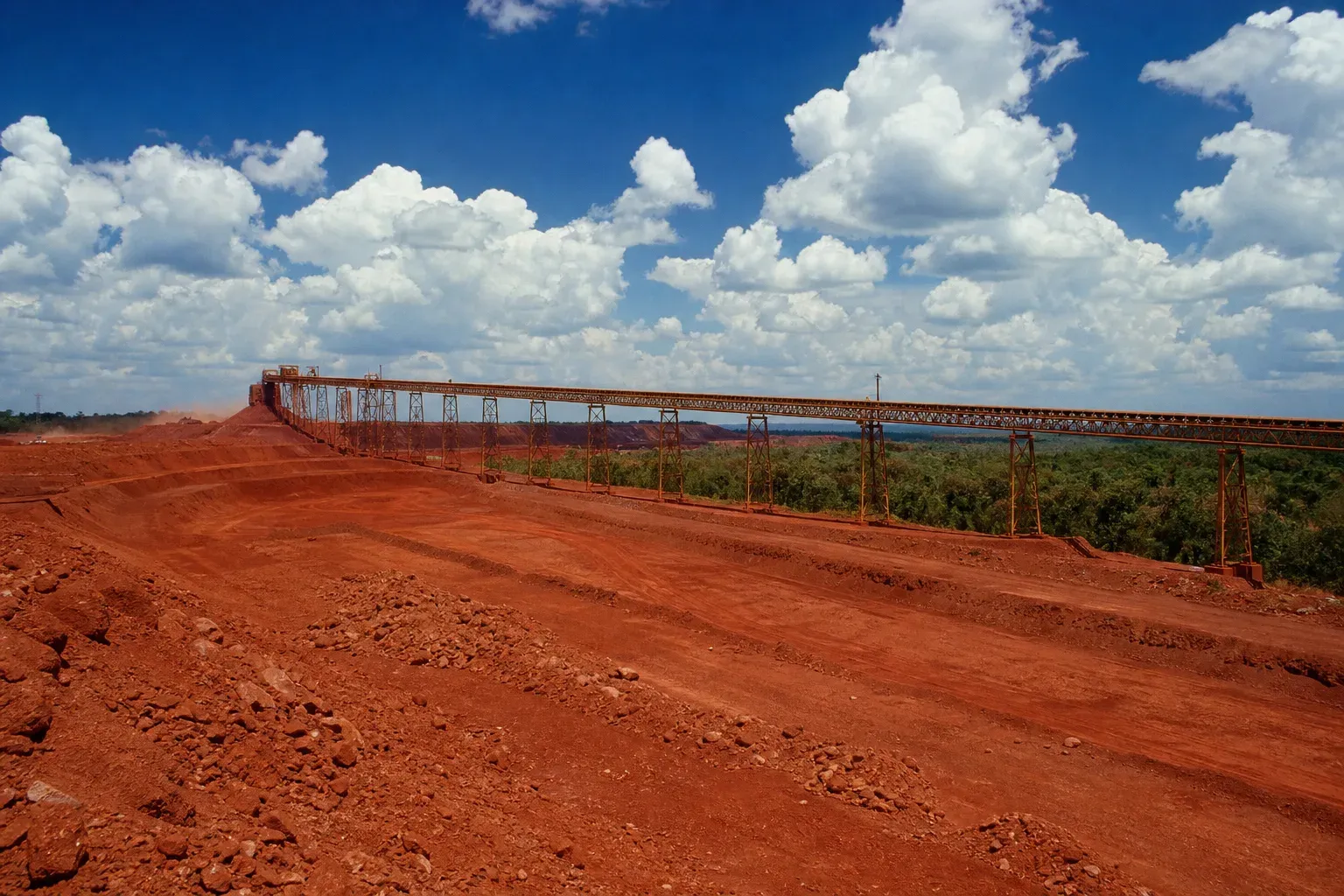
The deposit is a lateritic bauxite plateau requiring almost no processing. Ore is free-dug, crushed to 100 mm and hauled 42 kilometres on a dedicated sealed road to a river loading terminal, where it is barged to an offshore transhipment point on the Rio Nuñez and loaded onto ocean-going vessels.
FY2025 shipments were 4.41 Mt to refineries in Ireland, the United Arab Emirates, China and India. With 320 Mt of reserves, Fatala has the longest mine life in the portfolio at 28 years and will still be operating when every other current asset has closed.
Geology and product quality
Fatala bauxite is a gibbsitic (trihydrate) laterite formed by intense in-situ weathering of Palaeozoic dolerite and shale under a tropical climate. The ore blanket averages 8.4 metres thick beneath 1.5 metres of ferruginous duricrust and laterite overburden, and sits above a kaolinitic clay floor that provides a clean mining contact.
Product quality is the commercial heart of the asset. Available alumina averages 45.8% and reactive silica — the impurity that consumes caustic soda in the Bayer refining process and therefore drives refinery cost — averages 2.1%. That combination puts Fatala material in the premium band of the seaborne market and allows the operation to sell on long-term contracts indexed to alumina rather than into the spot bauxite market.
Mineral resources and ore reserves
| Category | Tonnes (Mt) | Available Al₂O₃ (%) | Reactive SiO₂ (%) | Fe₂O₃ (%) |
|---|---|---|---|---|
| Proved reserve | 186.0 | 46.3 | 2.0 | 18.4 |
| Probable reserve | 134.0 | 45.1 | 2.3 | 19.1 |
| Total ore reserve | 320.0 | 45.8 | 2.1 | 18.7 |
| Measured and indicated resource | 512.0 | 45.4 | 2.2 | 18.9 |
| Inferred resource | 148.0 | 44.6 | 2.5 | 19.6 |
Mining and materials handling
Mining is dry, free-dig and seasonal in character: the wet season from June to October reduces productivity and the operation builds a 900 kt stockpile ahead of it. Overburden is stripped by dozer and scraper, ore is loaded by excavator into 90-tonne rigid trucks, and the mined void is backfilled and re-contoured within twelve months of mining.
Two crushing lines reduce ore to a nominal 100 mm and feed a 12-kilometre overland conveyor to the river terminal stockpile. Barges of 6,000 tonnes carry ore 38 kilometres downriver to a transhipment anchorage, where floating cranes load Capesize and Panamax vessels at a rate of 42,000 tonnes a day.
Dust is the defining environmental and social issue for bauxite haulage in Boké, and it was the single largest source of community complaints in the operation’s first two years. Sealing the full haul road in 2023, enclosing all conveyor transfer points, and fitting covers to barges reduced recorded dust complaints from 214 in 2022 to 11 in 2025.
Operating performance
| Metric | FY2023 | FY2024 | FY2025 |
|---|---|---|---|
| Ore mined (Mt) | 3.4 | 4.0 | 4.5 |
| Shipped (Mt, dry basis) | 3.31 | 3.96 | 4.41 |
| Available Al₂O₃ shipped (%) | 45.6 | 45.7 | 45.9 |
| Reactive SiO₂ shipped (%) | 2.2 | 2.1 | 2.1 |
| Cash cost (US$/t FOB) | 31.4 | 29.8 | 28.6 |
Land, resettlement and livelihoods
Bauxite mining in Guinea takes land, and the land it takes is farmed. Fatala’s mining area overlaps rain-fed rice, cassava and cashew cultivation, and the project could not proceed without physically or economically displacing households. How that is handled determines whether the operation has consent.
Quintel applies the IFC Performance Standard 5 framework to all land access, whether or not a lender requires it. The northern pit resettlement, completed in 2025, moved 214 households into replacement housing with secure title, provided replacement agricultural land of equal or better productive capacity, and paid transitional income support for 24 months. An independent completion audit found 96% of households at or above their pre-move livelihood baseline; the remaining 4% are in an active remediation process with published milestones.
A grievance mechanism operates in six villages with a stated 30-day resolution target. In FY2025, 88 grievances were logged and 84 closed within target; the four exceptions related to compensation valuation disputes referred to independent assessors.
Environment
Bauxite mining is shallow, wide and reversible if handled properly. The technical challenge is soil, not rock.
- Progressive rehabilitation: topsoil is stripped separately, stockpiled for no more than 18 months to preserve the seed bank, and replaced during backfilling. 620 hectares have been rehabilitated to date against 810 hectares disturbed.
- Agricultural return: 71% of rehabilitated land has been returned to community agricultural use, with cashew and cassava yields on rehabilitated plots independently measured at 84–91% of undisturbed control plots by the third season.
- Water: no process water is used in mining. Sediment control ponds intercept runoff before it reaches the Fatala and Nuñez river systems; turbidity is monitored at nine points weekly and published quarterly.
- Marine: the transhipment anchorage operates under a spill response plan with equipment stationed on site, a strict no-ballast-discharge rule and an annual independent marine ecology survey.
- Emissions: the operation is diesel-dependent by nature. A 20 MW solar plant with storage, approved in 2025, will cut diesel use by an estimated 26% from 2027.
Outlook
Guidance for FY2026 is 4.6–4.9 Mt. The debottlenecking of the barge loading circuit approved in 2025 lifts nameplate capacity to 6 Mtpa by 2028, subject to river channel maintenance dredging permits.
Guinea’s government has stated a long-term policy objective of domestic alumina refining. Quintel supports that objective in principle and has committed to a pre-feasibility study for a refinery, jointly with the state, once power availability in the Boké corridor can be demonstrated at the scale a refinery requires.
Asset history
How Fatala got here
- 2019
Mining convention signed with the Republic of Guinea; construction begins.
- 2021
First shipment of 62,000 tonnes from the Rio Nuñez transhipment point.
- 2023
Haul road sealed and dust suppression programme completed through all villages.
- 2024
Second crushing line commissioned; capacity reaches 5 Mtpa.
- 2025
Resettlement action plan for the northern pit completed and independently verified.
Reporting standard
Mineral resources and ore reserves for this asset are estimated in accordance with the JORC Code (2012) and reviewed annually by an independent Competent Person. Resources are reported inclusive of reserves. Production figures are as reported in the FY2025 Annual Review.
Full resource and reserve statementLocation
Where this asset sits in the portfolio
Schematic map. Marker positions indicate the operating district, not a licence boundary.
- Producing
- Development
- Exploration
- Mbengwe Copper ComplexCopperbelt Province, Zambia · CopperProducing
- Lubumba Copper-Cobalt OperationLualaba Province, Democratic Republic of the Congo · Copper, CobaltProducing
- Asankran Gold MineWestern North Region, Ghana · GoldProducing
- Tazoult Silver MineAnti-Atlas, Drâa-Tafilalet, Morocco · SilverProducing
- Gamagara Manganese MineNorthern Cape, South Africa · ManganeseProducing
- Nyanga Manganese OperationHaut-Ogooué Province, Gabon · ManganeseProducing
- Fatala Bauxite OperationBoké Region, Guinea · BauxiteProducing
- Bagoé Gold ProjectSavanes District, Côte d'Ivoire · GoldDevelopment
- Erongo Copper ExplorationErongo Region, Namibia · CopperExploration
Seven operating mines, two development assets and 9 offices across nine countries. Every operation is managed by Quintel; we do not hold non-operated minority interests.
Enquiries
Questions about Fatala?
Community, procurement, media and offtake enquiries relating to this operation route to a named contact in the country where it operates.